
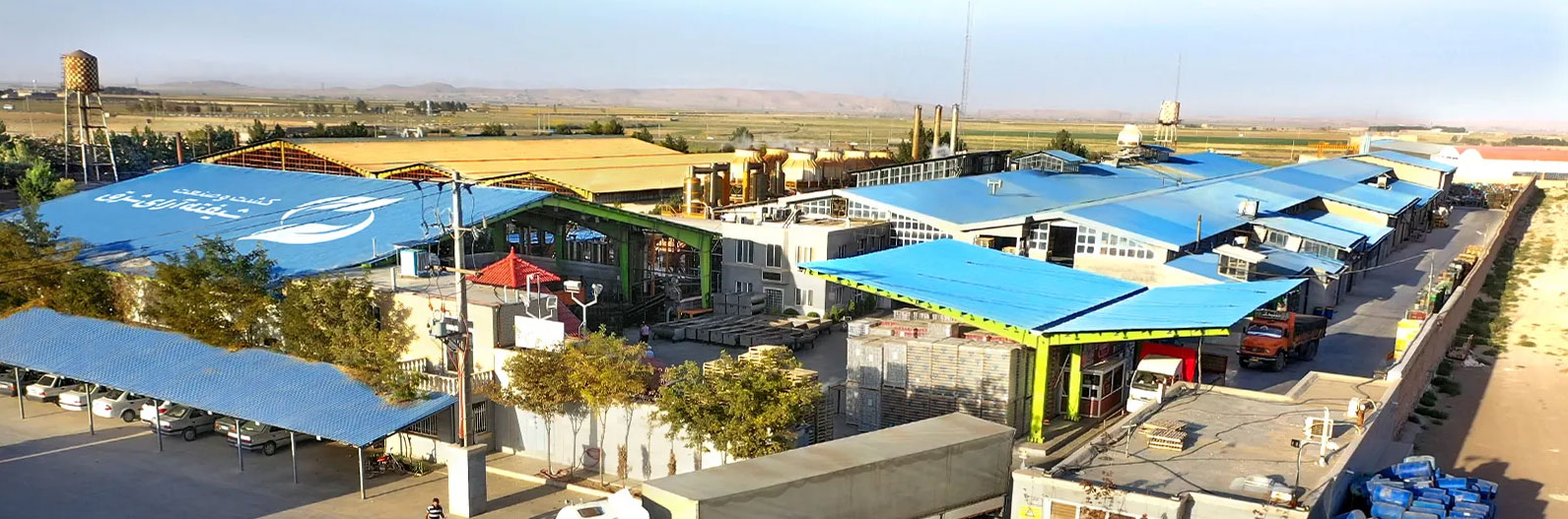

Shifteh Araye Shargh Agro-Industry
Shifteh Araye Shargh Agro-Industry is one of the largest producers of a wide range of food products in the country, backed by nearly half a century of experience. Established in 1994 in Mashhad, the company began producing more than 30 types of diverse products.
Today, a major portion of the company’s production includes various types of canned foods, compotes, tomato paste, jams, kashk (fermented whey), honey, pickles, and salted vegetables, achieving significant capacity in the field of food production.
From the outset, the holding has prioritized customer satisfaction and world-class quality by leveraging the expertise of committed managers, a specialized workforce in food processing industries, modern equipment, and high-capacity laboratories.
Over the years, the company, dedicated to improving and enriching the public’s food basket, has been honored with top awards from organizations such as the Food and Drug Administration, the National Standards Organization, the Trade Promotion Organization of Iran, the Agricultural Jihad Organization, and the Ministry of Industry, Mine and Trade, in recognition of its commitment to consumer rights.
Moreover, the use of cutting-edge technologies and the finest raw materials has enabled the holding to capture a significant share of exports to various Asian and European markets, including Iraq, Pakistan, Russia, and Australia, earning it the distinction of being a leading national exporter.
At Shifteh Araye Shargh Holding, we are committed to the continuous and comprehensive improvement of our production activities, aiming to achieve ever-greater consumer satisfaction and to proudly stand atop the peaks of Iran’s esteemed food industry.

Shifteh Araye Shargh Nationwide Distribution
Shifteh Araye Shargh Nationwide Distribution Company was established as a private joint stock company under registration number 82842 dated August 27, 2022, with national ID 14011449960, and registered with the Mashhad Companies Registration Office.
According to Article 2 of its Articles of Association, the company’s activities include: Engaging in all commercial affairs, export and import activities, providing services and production-related activities, industrial operations, collaboration and participation in production sectors and infrastructure investments, as well as the domestic rail transportation of goods. The company is also involved in the procurement, supply, sale, distribution, and export and import of food products, as well as all permitted pharmaceutical, health, and cosmetic products.

Shifteh Araye Shargh Metal Industries (Pre-Operational Stage)
Shifteh Araye Shargh Agro-industry Company, with the mission of combating famine and hunger, is dedicated to the production of healthy food products and is among the largest producers of tomato paste, compote, canned goods, and more in Iran. Recognizing the crucial role of packaging in preserving and maintaining food products, the company plans to launch a metal can production plant with half-kilogram and one-kilogram capacities by the end of 2025 in the industrial parks of Mashhad.
Food packaging is essential not only for protection against environmental and microbial factors but also as a key medium for extending shelf life and facilitating communication with consumers. Based on financial and economic feasibility studies, Shifteh Araye Shargh Company has deemed investment in the metal can production project economically viable. The project’s financial indicators, with a Net Present Value (NPV) of 3,753,564 million IRR and an Internal Rate of Return (IRR) of 34%, indicate high profitability, with the initial investment expected to be recovered within three years.
Aligned with the company’s value chain, the in-house production of metal cans will significantly reduce warehousing, marketing, and transportation costs. A major portion of the produced cans will be used internally for the company’s food production plant, leading to lower fixed costs and enhanced overall efficiency.

Shifteh Araye Shargh Packaging Industries (Pre-Operational Stage)
Nylon is one of the most important synthetic fibers, widely used across various industries such as apparel, household appliances, automotive, and aviation. It is produced by combining chemical substances known as monomers, which react with each other to form long, durable chains called polymers. These polymers can exhibit a range of different properties.
Nylon is a highly versatile polymer, with polyethylene serving as the fundamental base polymer. Its composition involves natural elements including nitrogen, oxygen, hydrogen, and carbon, which together contribute to its flexibility and durability.
The primary use of nylon is in the production of textile fibers and fabrics; however, it also plays a critical role in the manufacturing of industrial components across the packaging, automotive, and textile industries, among others. Nylon is characterized by its strength, moisture resistance, wrinkle resistance, and anti-contamination properties, alongside its excellent mechanical strength. It also has a high melting point due to the hydrogen bonds formed between the polymer chains. While these polymers are generally resistant to dissolution in most solvents, they are soluble in formic acid and polyamides.
To achieve the final product, nylon is manufactured in various grades, with Types 6 and 6.6 being the most widely used. These materials find applications in industrial, agricultural, and domestic settings, with differences in thickness, tensile strength, and elasticity depending on the intended use.
Broadly, nylon products are classified into two main categories: wide-width nylon and packaging nylon. Each product mentioned falls into one of these two categories. For example, construction-grade, agricultural, and greenhouse nylon films belong to the wide-width category, while shrink wrap, bubble wrap, and stretch films are considered part of the packaging nylon category.

Shifteh Araye Shargh Carton Industries (Pre-Operational Stage)
Packaging represents the final stage of the production process for any product, and its importance is widely recognized. Cartons are essential packaging products, serving not only as containers but also as protective barriers for the goods they encase. This unit operates by purchasing pre-manufactured sheets and converting them into cartons.
With the rapid growth of the packaging and transportation industries, the demand for cartons has increased significantly. Due to their extensive range of applications across various industries, carton production presents a highly promising investment opportunity. By offering protective and efficient packaging, the quality and shelf life of products can be significantly enhanced.
Carton boxes are considered one of the most critical components of packaging equipment, used for packing food products, chemicals, consumables, and more. As a result, the business plan for carton production offers numerous advantages, including:
- Simplifying the transportation process of various products and goods
- Creating direct and indirect employment opportunities
- Meeting the market demand for a variety of carton boxes
- Extending the shelf life of products and equipment
- Enabling the export of carton boxes to neighboring countries and generating foreign currency income